Most email problems that reach a small team look like delivery problems at first. Open rates slide, a campaign gets throttled, someone asks why the welcome sequence went quiet last month. The cause usually sits further upstream, in the list itself: addresses collected two years ago at a trade show, typos nobody caught, disposable domains from a giveaway, a handful of role accounts that were never going to reply to anything.
An email validation API is one of the few pieces of marketing infrastructure where the payoff is easy to measure. You stop sending to addresses that cannot receive mail, your bounce rate stays under the threshold your provider actually enforces, and your reporting stops flattering you. At Aisendia we treat this as plumbing rather than a growth tactic. Plumbing is worth getting right early, because everything downstream inherits its problems.
What an Email Validation API Actually Checks
Vendors describe their checks differently, but the useful ones are fairly standard and they run roughly in order of cost.
The cheap layer is syntax. This is what a regex catches: a missing @, illegal characters, a domain that could not exist. Plenty of teams stop here. Plenty of teams still bounce.
Next the service resolves the domain and asks whether it publishes MX records at all. A domain with no mail exchange record cannot accept mail regardless of how well formed the address looks, and this check alone clears out most of the damage done by manual data entry.
Then comes the mailbox check over SMTP. The validator opens a conversation with the receiving server and asks whether that specific mailbox exists, without delivering anything. This is the layer that separates a real validator from a formatter. It is also the layer that costs the vendor money, which is why free tiers tend to be quiet about whether they run it.
On top of that sit the risk flags: disposable domains, role accounts such as info@ or admin@, known complainers, addresses that read like typos of the big providers. Not all of these are invalid. They are simply worth routing somewhere other than your main sequence.
The last one is catch-all detection, and it deserves more attention than comparison tables give it. Some domains accept every address and sort it out internally, so a mailbox check comes back inconclusive by design. Honest services return unknown or risky and let you decide what to do. Less honest ones return valid, keep their published accuracy score high, and leave your bounce rate to discover the truth two weeks later.
Three Places It Belongs in the Stack
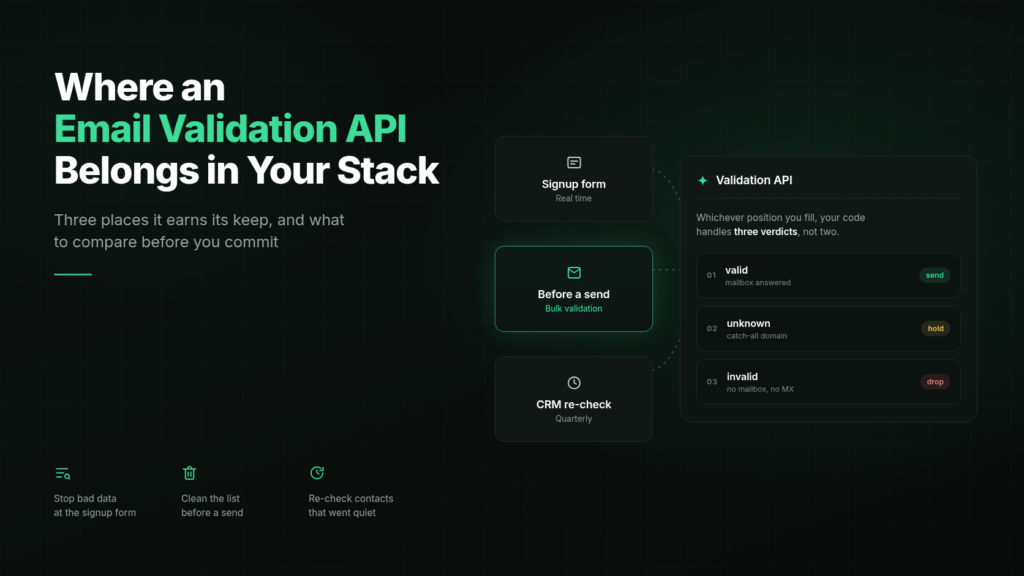
The first is the signup form, in real time. A single-address endpoint called on blur or on submit stops bad data before it enters the database. Two rules make this survive contact with production. Set a latency budget, usually a few hundred milliseconds, and fail open when it is exceeded, because a validation timeout should never cost you a signup. Then decide in advance whether a risky verdict blocks the form or just tags the record. Blocking everything risky is how you quietly lose real customers who happen to use an unusual provider.
The second is the pre-send cleanup. Bulk email validation is the version most teams meet first: upload a list, wait, download the verdicts. It belongs before any large campaign, and before any list you did not collect yourself gets loaded into a sending tool. Import a purchased list without this step and you are gambling with a sender reputation that took months to build.
The third runs on a schedule inside the CRM. Lists decay as people change jobs; the number usually quoted is around 22 percent a year, from a HubSpot study, and whatever the real figure is for your audience, it compounds. A quarterly re-check of inactive segments keeps that from turning into one painful cleanup every few years. This is the least interesting of the three, which is why it never gets built unless somebody puts it on a calendar.
What to Compare Before You Commit
Once you start reading vendor pages, the differences that matter are usually not the ones on the pricing table.
- How credits expire. Pay as you go with credits that never expire suits a team that sends in bursts, while a monthly subscription suits steady real-time volume. Getting this backwards is the most common way to overpay.
- Whether you are billed for inconclusive verdicts. Some services charge for unknowns, some do not, and on a list of any size that difference is real money.
- Latency and rate limits, which barely matter for a nightly batch and decide everything for a signup form.
- Async support. Any bulk job past a few thousand addresses should be submitted asynchronously with a webhook callback rather than held open on an HTTP connection.
- Data handling. You are uploading personal data to a third party. Where it is stored, how long it is kept, and whether there is a processing agreement are questions your legal review will ask eventually, so ask them first.
Two things get conflated here and are worth separating. Your sending platform, whether that is the Mailchimp, SendGrid, Mailgun or Brevo API, tells you what happened after you sent. A validation service tells you what would happen before. Most ESPs include some hygiene of their own, and it is genuinely light: they suppress hard bounces they have already seen, which does nothing about the addresses you have never mailed. A dedicated service such as uChecker’s email verification tool covers that gap, through a single-address endpoint or a bulk upload depending on which of the three positions you are filling.
The Integration Is Smaller Than You Expect
This is usually where a decision gets postponed for no good reason. In Node.js, real-time validation on a signup route is a few lines:
const check = async (email) => {
  const ctrl = new AbortController();
  const timer = setTimeout(() => ctrl.abort(), 400);
  try {
    const res = await fetch(`${API}/verify?email=${encodeURIComponent(email)}`, {
      headers: { Authorization: `Bearer ${process.env.VALIDATION_KEY}` },
      signal: ctrl.signal,
    });
    return (await res.json()).status;   // valid | invalid | unknown
  } catch {
    return 'unknown';                    // fail open, never block a signup
  } finally {
    clearTimeout(timer);
  }
};
In Python, the scheduled cleanup over an existing table has the same shape, batched instead of per request:
import httpx

def verify_batch(emails: list[str]) -> dict[str, str]:
    r = httpx.post(
        f"{API}/bulk",
        json={"emails": emails},
        headers={"Authorization": f"Bearer {KEY}"},
        timeout=30,
    )
    r.raise_for_status()
    return {row["email"]: row["status"] for row in r.json()["results"]}
Store the verdict and the date you checked it next to the address. Six months later, when somebody asks why a contact stopped receiving mail, that column answers the question in seconds instead of starting an investigation.
When the List Is Clean and the Mail Still Does Not Land
Validation solves one class of problem: addresses that cannot receive mail. It does nothing for mail that is refused, delayed, or filed into spam by a recipient who exists and would have been glad to read it.
When a verified address goes quiet, the evidence is in the message headers, and headers are oddly underused for something that ships with every email. The Received chain lists every hop and the delay at each one, which turns “our email is slow” into a specific server. The Authentication-Results line reports what the receiving side concluded about your SPF, DKIM and DMARC, which is frequently different from what your DNS records led you to expect. Filtering systems often add their own scoring header naming the rule that fired.
Reading raw headers by hand is tedious and easy to get wrong, so paste them into an email header analyzer and read the parsed output instead. Ask whoever reported the problem to forward the original message with full headers. Run one failing message and one that arrived normally, then compare the two. The difference between them is usually the whole answer.
How Aisendia Helps
Aisendia helps small teams work out where automation actually belongs in day to day operations, rather than adopting every tool that promises to change everything. For email that usually means a short audit of where addresses enter the system, one validation step at the point of entry, one scheduled cleanup, and a documented way to diagnose delivery complaints when they arrive. Three moving parts, not a platform migration.
The same start-small principle applies here as everywhere else. If you are deciding what to tackle first across a broader marketing stack, our guide on what to automate first in AI marketing covers how to sequence that work without breaking the things you already rely on.
Conclusion
An email validation API earns its place in three specific spots: the signup form, the pre-send cleanup, and a scheduled re-check of contacts who have gone quiet. Pick a vendor by how it reports catch-all domains and how it bills unknown results, not by the accuracy number on the landing page. Then keep a header analyzer within reach, because once the list is clean, the failures that remain are authentication and filtering problems wearing the same costume.