AI is becoming a normal part of marketing, but many businesses still approach it in one of two extreme ways. Some expect AI to replace most of the work. Others avoid it completely because they are afraid of generic content, wrong answers or loss of control.
The better approach is somewhere in the middle.
AI can help marketing teams work faster, organize information, prepare drafts, summarize data and support repetitive tasks. But it works best when people still guide the strategy, review the output and make final decisions.
At Aisendia, we see AI as a practical assistant for marketing workflows, not as a replacement for marketing judgment.
AI Is Most Useful When the Task Is Clear
AI works better when it is given a specific job. A vague request like “improve our marketing” is not enough. But a focused task can be very useful.
For example, AI can help with:
drafting email variations;
summarizing customer feedback;
creating blog post outlines;
turning webinar notes into content ideas;
preparing social media captions;
organizing lead information;
summarizing campaign performance;
suggesting improvements for landing page copy.
These tasks are useful because they are specific. The AI does not need to understand the entire business at once. It only needs to support one clear step in the marketing process.
That is why businesses should not start with a huge AI transformation project. It is usually smarter to start with one repeated task that slows the team down.
Content Creation Becomes Easier, But Not Automatic
Content is often the first area where companies test AI. That makes sense. Marketing teams need blog posts, landing pages, emails, ads, social posts, product descriptions and campaign ideas.
AI can help create first drafts, outlines, headlines and content variations much faster than a person starting from a blank page.
But this does not mean content should be published without review.
AI-generated content can be too generic. It may repeat common phrases, miss brand tone or make claims that need checking. A good content workflow should include human direction before the draft and human editing after it.
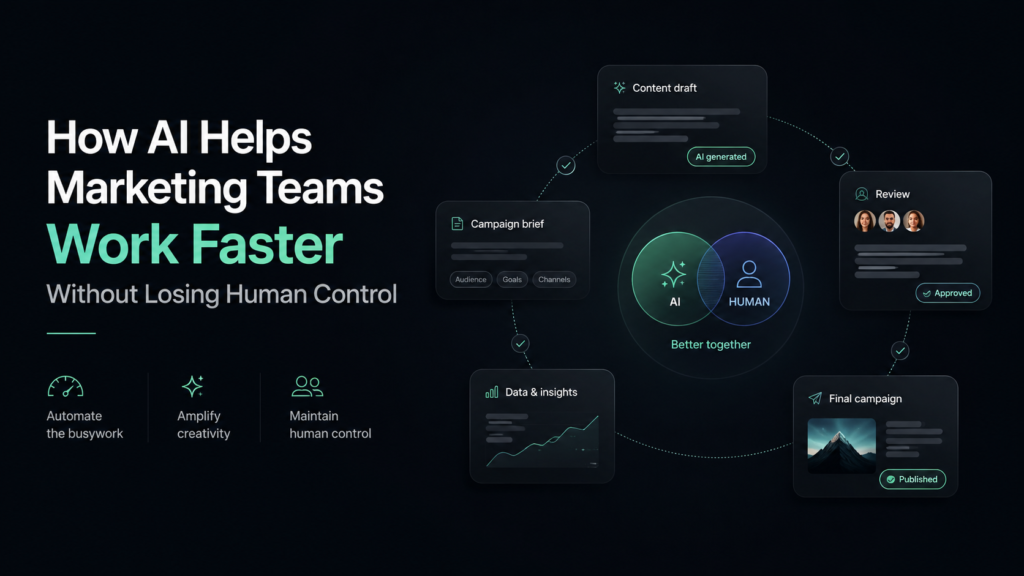
A practical AI content workflow may look like this:
the marketer defines the audience and goal;
AI creates an outline or draft;
the marketer edits structure and tone;
AI helps create variations or summaries;
a human checks accuracy and final message before publishing.
This keeps the speed advantage without giving up quality control.
AI Can Improve Lead Follow-Up
Many businesses lose opportunities not because they lack leads, but because follow-up is inconsistent. Contact forms are missed. Replies are delayed. Sales notes are scattered. Leads are not grouped by urgency or interest.
AI can help organize this process.
For example, when a new inquiry comes in, AI can summarize the message, identify the main need, suggest a response draft and send a notification to the right person. It can also help group leads by service type, location, budget range or priority.
This does not mean AI should make final sales decisions. It means the team receives cleaner information and can respond faster.
That small improvement can make a real difference, especially for small businesses where one person handles several marketing and sales tasks at once.
Reporting Becomes Easier to Understand
Marketing reports often contain too much data and not enough explanation. A team may have numbers from ads, email campaigns, website analytics, social media and CRM tools, but still struggle to understand what matters.
AI can help turn raw information into clearer summaries.
It can help answer questions like:
Which campaign performed better?
Which landing page had weaker conversion?
Which email subject line received more engagement?
What changed compared with last month?
What should we test next?
Of course, AI should not replace proper analysis. But it can speed up the first layer of reporting. Instead of spending time formatting notes, marketers can spend more time deciding what to improve.
This is one of the areas where AI can be very practical because it supports decision-making without pretending to be the decision-maker.
Automation Should Start Small
One common mistake is trying to automate too much too quickly. A business hears about AI automation and immediately imagines a fully automated marketing system that writes, sends, analyzes and optimizes everything.
In reality, that can create problems. Over-automation may lead to poor customer communication, wrong messages, duplicated tasks or content that no one reviews.
A better starting point is simple automation.
For example:
send a summary of every new contact form submission;
create a draft reply for new leads;
save qualified leads into a spreadsheet or CRM;
generate a weekly campaign summary;
turn meeting notes into action items;
create content ideas from customer questions.
These workflows are not dramatic, but they save time. More importantly, they are easier to control.
Aisendia usually recommends starting with one workflow, testing it, improving it and only then adding more automation.
Human Review Is Not Optional
The most important part of AI marketing is human review.
AI can be fast, but it does not understand your business the same way your team does. It does not know your customer relationships. It may not understand sensitive situations. It may produce text that sounds acceptable but does not match your brand.
Human review is needed for:
strategy;
final messaging;
sensitive customer communication;
brand voice;
legal or financial claims;
campaign approval;
important business decisions.
This is not a weakness. It is how AI should be used responsibly.
The goal is not to remove people from marketing. The goal is to remove repetitive work from people, so they can focus on better decisions.
The Right AI Tools Depend on the Workflow
There is no single best AI marketing tool for every business.
One company may need help with content planning. Another may need email automation. Another may need better reporting. Another may simply need help choosing which tools are worth paying for.
That is why tool selection should come after workflow analysis.
Before choosing tools, a business should ask:
What marketing task takes too much time?
Where do errors or delays happen?
Which tasks repeat every week?
What information does the team need faster?
Which outputs must always be reviewed by a person?
Once those questions are clear, choosing tools becomes easier.
Aisendia helps businesses avoid tool overload by connecting AI tools to actual marketing tasks.
Conclusion
AI can help marketing teams work faster, but only when it is used with structure. The best results usually come from clear tasks, simple workflows, human review and realistic expectations.
Businesses do not need to automate everything at once. They can start with one useful area: content drafts, lead summaries, follow-up support, reporting or campaign planning.
Used well, AI does not replace human marketing work. It supports it. It helps teams spend less time on repetitive tasks and more time on strategy, creativity and customer understanding.
If your business wants to use AI in marketing but needs a clear starting point, Aisendia can help you review your current workflow and build a practical plan.
Contact Aisendia to discuss AI marketing strategy, automation and content workflows for your business.